Sign in
  • Sign-in
  • Sign up

enter image description here

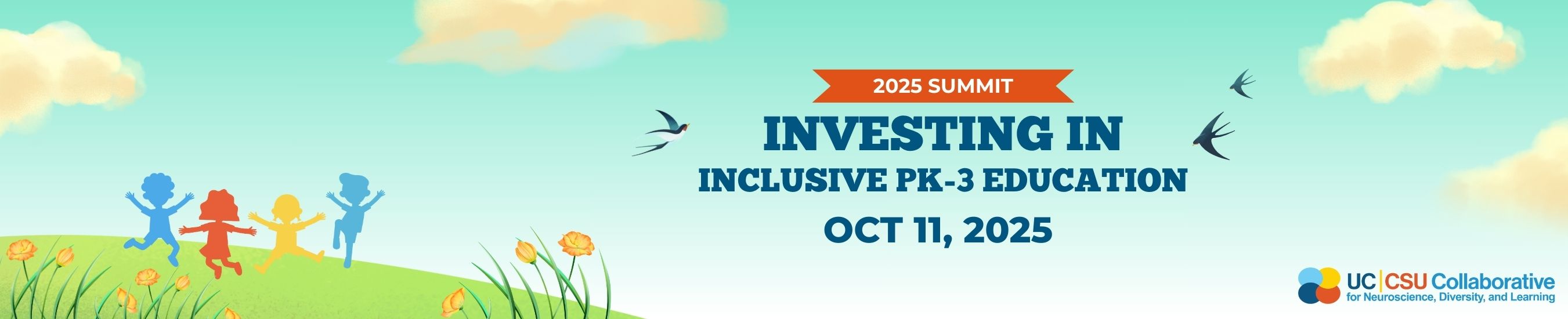
2025 Summit: Investing in Inclusive PK-3 Education - Resource List

Explore resources shared throughout the 2025 Summit — organized by Arraya, Keynote, and Track themes.


Arraya Learning Resources

UC|CSU Collaborative 2025 Summit - Investing in Inclusive PK-3 Education - Registration Page

Conference

Supporting Innovative Practices Collection

Resource Collection

Core Components of Early Child Development

Course Series

Language, Literacy, and Dyslexia Series

Course Series

Policy Brief: Assessing Transitional Kindergarten’s Impact on Elementary School Trajectories

Website

Core Components of Reading

Course Series
UC|CSU Collaborative 2025 Summit - Investing in Inclusive PK-3 Education - Registration Page

UC|CSU Collaborative 2025 Summit - Investing in Inclusive PK-3 Education This year’s virtual summit brings together educators, administrators, and researchers in child development to explore both the importance of inclusive PK-3 education and practical strategies to maximize its impact. By bridging research and practice, this conference aims to empower educators and decision-makers with the knowledge and strategies needed to maximize over $5 billion in annual federal and state funding toward early childhood education—ensuring that resources translate into lasting impacts for young learners. Learn more here. Speaker Lineup: Conference ...

Conference
5.5 hours
Supporting Innovative Practices Collection

This collection of videos and printable tools are designed to help educators build more inclusive, equitable, and intentionally designed learning environments for all students, especially those with disabilities. Developed by the Supporting Innovative Practices (SIP), a grant-funded project by the California Department of Education, in partnership with the El Dorado and Riverside County Offices of Education. These resources support schools in transforming exclusionary practices through systemic change and advocacy. SIP’s mission is to uphold human dignity by challenging exclusionary practices through systemic change and advocacy, ensuring ...

Resource Collection
Core Components of Early Child Development

This five-part series offers a comprehensive, research-based introduction to the core components of early childhood development from birth to age eight: brain, language, motor, social-emotional, and cognitive development. Each course explores foundational concepts, key developmental milestones, and the dynamic interplay between biological maturation and environmental experiences. Participants will gain an understanding of how brain systems support learning across domains, how language and motor skills emerge and interact, how social and emotional capacities develop through relationships, and how cognitive processes like memory, attention, and problem-solving evolve ...

Course Series
Language, Literacy, and Dyslexia Series

The Language, Literacy, and Dyslexia series supports the literacy development of a wide range of learners, including those with dyslexia, within the context of today’s diverse communities, families, and student populations. Course content, developed by a multidisciplinary team of teacher educators, reading researchers, and neuroscientists reflects the most current evidence-based educational practices. Courses are aligned with the California Dyslexia Guidelines and Literacy Standard 7 Teaching Performance Expectations (TPEs). Each course includes an extensive collection of relevant readings, resources, and references. 

Course Series
Policy Brief: Assessing Transitional Kindergarten’s Impact on Elementary School Trajectories

California’s Transitional Kindergarten (TK) program provides an additional year of schooling within the K–12 system that aims to prepare children for kindergarten. Launched a decade ago with limited eligibility, the program will be expanded to all four-year-olds by 2025–26. Little is known about TK’s longer-term impact—especially among multilingual students and students with disabilities, who might benefit from early identification. This resource takes stock of TK’s impact so far in an effort to help the state expand it successfully.

Website
Core Components of Reading

This comprehensive series presents the essential components of early literacy development, including Oral Language, Phonological Awareness, Decoding, Vocabulary, Fluency, Reading Comprehension, and Spelling. Each course is thoughtfully designed to examine language and literacy development from multiple perspectives, focusing on effective, research-based teaching strategies. Leveraging current research with practical strategies, this series will help educators understand not just what to teach, but how to reach the diversity of learners in their classrooms. 

Course Series

  • 2025 Summit Lunch & Learn Padlet
  • 🎤 Keynote: Cultivating Joy & Learning for All Across the Early Grades

    • We Are the Change We Seek: Advancing Racial Justice in Early Care and Education.
    • Advancing Equity and Embracing Diversity in Early Childhood Education: Elevating Voices and Actions
    • Start with Equity: 14 Priorities to Dismantle Systemic Racism in Early Care and Education
    • The Next Generation of Head Start: Expanding Access, Improving Quality, Advancing Equity
    • A New Vision for High-Quality Preschool Curriculum
    • Building a Universal Preschool System Around Head Start: Guiding an Equitable Pandemic Recovery
    • Learning, Joy, and Equity: A New Framework for Elementary Education
    • Don’t Look Away - Embracing Anti-Bias Classrooms
    • Assessing Classroom Sociocultural Equity Scale: Manual for Pre-K to Grade 5

    🧩 Track 1: Preserving Play, Powering Learning: What PK-3 Really Needs

    • Learning Through Play: A Review of the Evidence
    • What if Teaching Mirrored How Human Brains Learn?
    • Center on the Developing Child - Harvard University
    • Skills for a Changing World: National Perspectives and the Global Movement
    • How People Learn
    • How People Learn 2
    • Foundations for a New Science of Learning
    • Active-Constructive-Interactive: A Conceptual Framework for Differentiating Learning Activities
    • Developmentally Appropriate Practice in Early Childhood Programs Serving Children from Birth Through Age 8
    • San Diego County Office of Education Padlet on Developmentally Appropriate Practices and Play
    • The Active Playful Learning Model: Reimagining Education for the 21st Century - Brookings Webinar
    • Curated list of resources on Playful Learning from Dr. Jennifer Zosh

    🤝 Track 2: Starting Strong: Equity and Inclusion in Early Childhood

    • CSU Early Literacy & Mathematics COLLAB Modules
    • Why the PK-3 ECE Credential Matters
    • Tiny Innovators: ECE STEAM Makerspace Toolkit
    • Supporting Innovative Practices (SIP) Collection on Arraya Learning
    • Supporting Innovative Practices (SIP) UPK Padlet
    • Interactive Early Childhood UDL Crosswalk
    • CVUSD Guiding Principles: ESN
    • CVUSD ESN Organizing the Learning Environment
    • TK-2 Unit Plan (sample)

    Last updated October 2025.

    Welcome to Arraya Learning!

    Arraya Learning is a centralized, evidence-based resource hub developed and vetted by leading experts across the University of California (UC) and California State University (CSU) systems. It’s designed to meet the evolving needs of educators, teacher educators, and leaders across California.
    1 / 3

    Getting Started

    Based on the preferences you selected when creating your account, we will personalize your learning experience by recommending resources that fit your interests. You can change your interests or update your email settings on the My Profile page.

    Use the Search bar or Catalog to find specific resources or browse through recommended or recently added resources.

    The LEARN menu keeps track of your activities and is your way to access Courses, Trainings, Webinars, and more.
    2 / 3

    Key Terms to Get You Started

    Course - Interactive, asynchronous learning courses that can be taken independently.
    Webinar - A live, informational session held virtually or in-person. Recordings are available after the live session.
    Training - A workshop, seminar, or presentation held virtually. Pre-recorded “anytime training” sessions are also available.
    Resource Collection - A curated set of resources on a specific topic or strategy.

    Find these and more on the Arraya Homepage and in the LEARN menu!
    3 / 3
    UC|CSU Collaborative for Neuroscience, Diversity, and Learning University of California The California State University
    Copyright © 2024-2025 UC|CSU Collaborative for Neuroscience, Diversity, and Learning
    About   |   Terms   |   Privacy   |   Accessibility   |   Contact