Sign in
  • Sign-in
  • Sign up

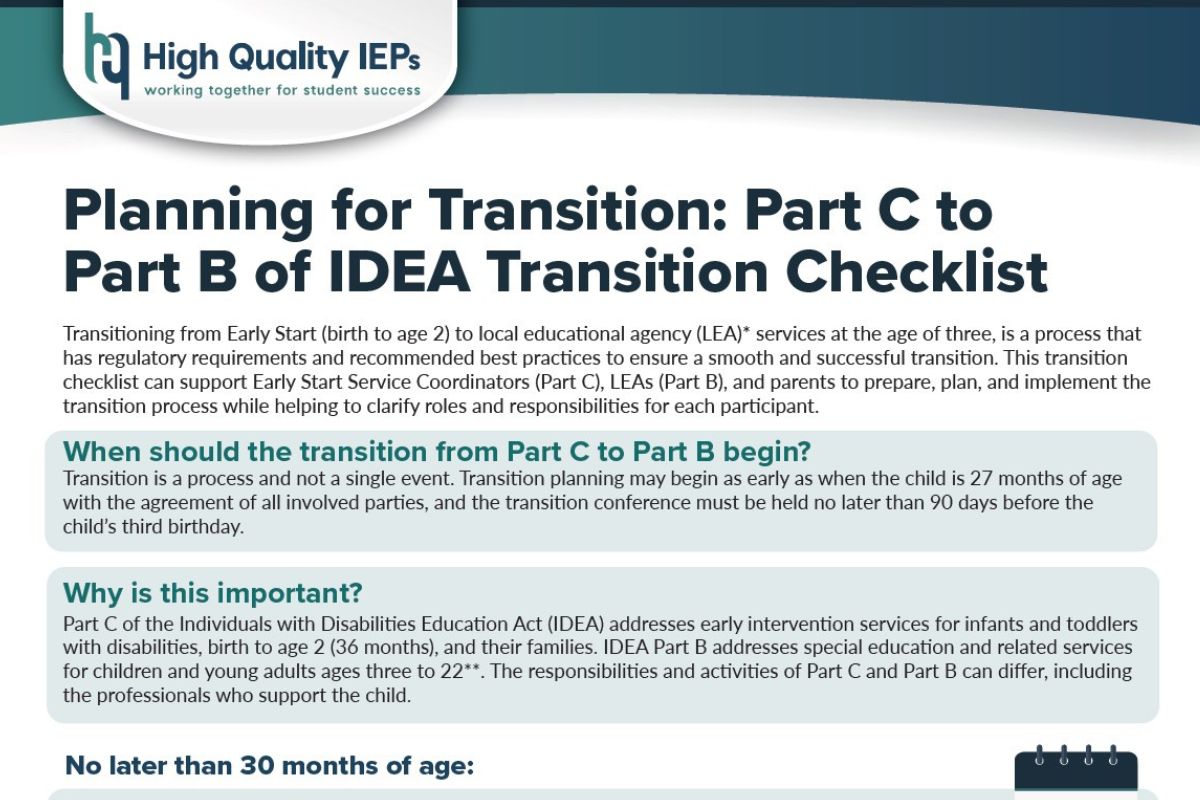
Preparing for Part C to Part B Transition Checklist
Manage

Add to lists

Only you can see these lists - view your lists on the My Learning page.


Unsave

This will also remove this resource from any lists you have added it to.

Yes, I would like to unsave
detail-img-lg
Type:
  Printable Tool
Authors:
Heather DiFede; Leo Mapagu; Jennifer Yales, Ed.D.; Noreen Rodriguez-Lippincott; and Hinda Nadif, Ed.D.
Developed by:
High Quality IEPs (HQ IEPs)
Relevant categories:
Child and Caregivers Disabilities Special Education
This is a printable tool.
Click to download and review.
View document

Overview


This planning guide supports families and service providers through the transition from early intervention (birth to 3, Part C) to preschool special education services (age 3+, Part B). It breaks down what to expect, timelines to watch for, and steps to take to ensure a smooth, supportive handoff between systems.

TPE Alignment:

  • TPE 1.2 - Maintain ongoing communication with students and families, including the use of technology to communicate with and support students and families, and to communicate achievement expectations and student progress.
  • TPE 5.8 - Use assessment data, including information from students' IEP, IFSP, ITP, and 504 plans, to establish learning goals and to plan, differentiate, make accommodations and/or modify instruction.
  • TPE 6.4 - Demonstrate how and when to involve other adults and to communicate effectively with peers and colleagues, families, and members of the larger school community to support teacher and student learning.

Navigating this Collection:

HQ IEPs > During the IEP

  Keywords: ADR, Alternative Dispute Resolution, Checklist, Collaboration, Disability, Goals, IEP, IEP Compliance, IEP Dispute, IFSP, Individualized Education Program, Individualized Family Services Plan, Infant, Part C, Special Education, Student Outcomes, Student-Centered, Toddler, TPE 1.2, TPE 5.8, TPE 6.4, Transition

Related items


During the IEP

This section prepares educators to lead and participate in IEP meetings that are legally compliant, inclusive, and centered on student growth. Through step-by-step guides, videos, and planning tools, learners will explore how to interpret assessment data, identify areas of need, develop measurable goals, and select supports and services that align with each student’s strengths. Emphasis is placed on building collaborative, culturally responsive partnerships with families and ensuring that all IEP components—from present levels to service delivery—are developed through shared understanding and data-informed decisions. Navigating this Collection: ...

 Resource Collection
  Added on 10/16/2025
Fostering Family School Partnerships

This resource highlights the importance of meaningful partnerships between families and educators in the IEP process. It offers ideas for improving communication, building trust, showing empathy and respect, and honoring families’ cultural values—so every child’s learning plan is built on collaboration and shared understanding. TPE Alignment: TPE 1.2 - Maintain ongoing communication with students and families, including the use of technology to communicate with and support students and families, and to communicate achievement expectations and student progress. TPE 6.4 - Demonstrate how and when to involve other adults ...

 Printable Tool
  Added on 10/16/2025
What are IEPs? Unlocking Doors of Possibilities

This short, animated video introduces the Individualized Education Program (IEP) as more than just a legal requirement — it’s a collaborative, student-centered plan designed to unlock potential and support success. Viewers will learn the purpose of an IEP, who participates in the process, and why centering student voice and family partnership is essential. It also encourages educators to reflect on their own mindsets and beliefs, reminding us that a high-quality IEP can open doors and lead to transformative outcomes. TPE Alignment: TPE 1.2 - Maintain ongoing communication ...

 Video
  Added on 10/16/2025
Added on 10/16/2025   ·   Last updated on 10/16/2025

Welcome to Arraya Learning!

Arraya Learning is a centralized, evidence-based resource hub developed and vetted by leading experts across the University of California (UC) and California State University (CSU) systems. It’s designed to meet the evolving needs of educators, teacher educators, and leaders across California.
1 / 3

Getting Started

Based on the preferences you selected when creating your account, we will personalize your learning experience by recommending resources that fit your interests. You can change your interests or update your email settings on the My Profile page.

Use the Search bar or Catalog to find specific resources or browse through recommended or recently added resources.

The LEARN menu keeps track of your activities and is your way to access Courses, Trainings, Webinars, and more.
2 / 3

Key Terms to Get You Started

Course - Interactive, asynchronous learning courses that can be taken independently.
Webinar - A live, informational session held virtually or in-person. Recordings are available after the live session.
Training - A workshop, seminar, or presentation held virtually. Pre-recorded “anytime training” sessions are also available.
Resource Collection - A curated set of resources on a specific topic or strategy.

Find these and more on the Arraya Homepage and in the LEARN menu!
3 / 3
UC|CSU Collaborative for Neuroscience, Diversity, and Learning University of California The California State University
Copyright © 2024-2025 UC|CSU Collaborative for Neuroscience, Diversity, and Learning
About   |   Terms   |   Privacy   |   Accessibility   |   Contact
Saved! (Manage)
Unsaved
Changes saved! (Manage)
Are you sure you want to unsave this resource?