Sign in
  • Sign-in
  • Sign up

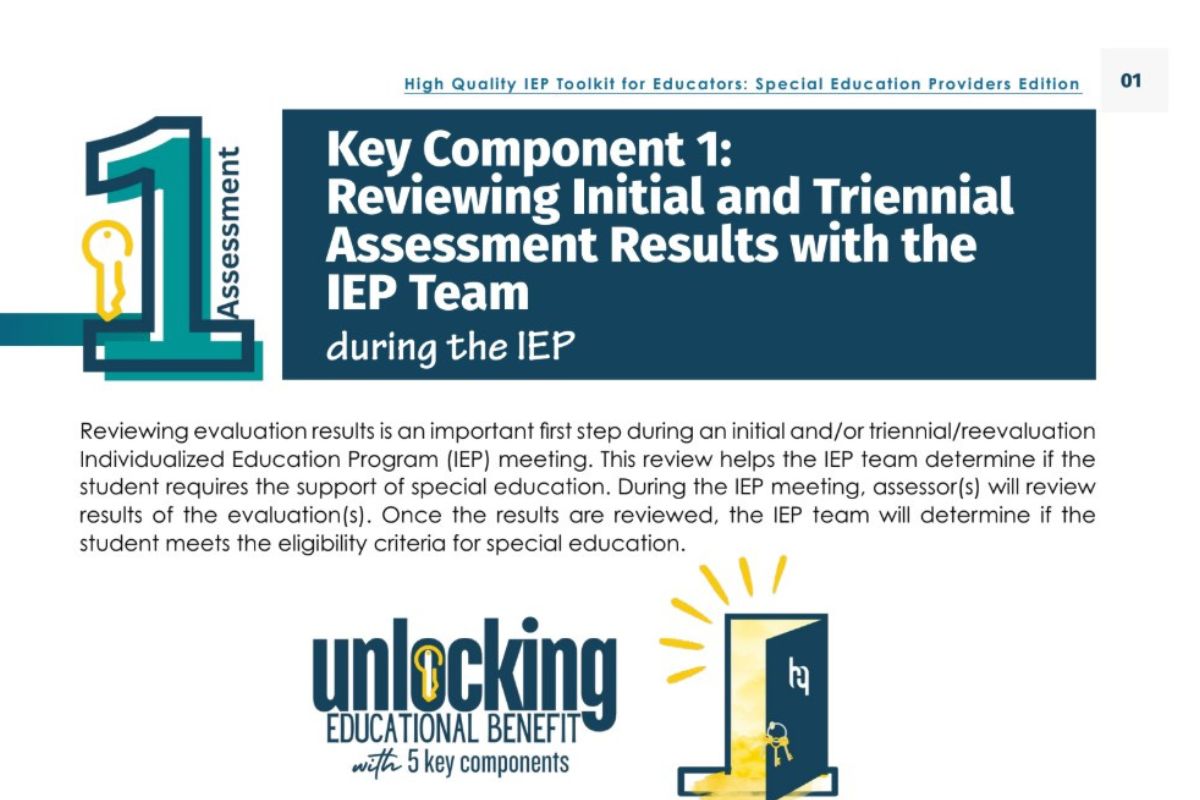
Key Component 1: Reviewing Initial and Triennial Assessment Results with the IEP Team
Manage

Add to lists

Only you can see these lists - view your lists on the My Learning page.


Unsave

This will also remove this resource from any lists you have added it to.

Yes, I would like to unsave
detail-img-lg
Type:
  Printable Tool
Authors:
Heather DiFede; Leo Mapagu; Jennifer Yales, Ed.D.; Noreen Rodriguez-Lippincott; and Hinda Nadif, Ed.D.
Developed by:
High Quality IEPs (HQ IEPs)
Relevant categories:
Disabilities Screening and Assessment Special Education
This is a printable tool.
Click to download and review.
View document

Overview


This guide explains how to review and interpret assessment results during initial and triennial IEP meetings. It outlines how eligibility for special education is determined, provides tips for communicating technical information in family-friendly language, and emphasizes the importance of collaborative decision-making among team members. It also highlights what to do when there are disagreements about eligibility.

TPE Alignment:

  • TPE 5.8 - Use assessment data, including information from students' IEP, IFSP, ITP, and 504 plans, to establish learning goals and to plan, differentiate, make accommodations and/or modify instruction.

Navigating this Collection:

HQ IEPs > During the IEP > Key Components of the IEP Process > Key Component 1: Assessment

  Keywords: Assessment, Collaboration, Disability, Educational Benefit, Eligibility, Goals, IEP, IEP Compliance, Individualized Education Program, Special Education, Student Outcomes, Student-Centered, TPE 5.8

Related items


Key Component 1: Assessment

This resource covers the first step of reviewing evaluation results during an initial or triennial/reevaluation IEP meeting. It provides guidance on explaining assessment outcomes, determining special education eligibility, addressing multiple eligibility areas, handling situations where a student does not qualify, documenting discussions, and managing disagreements about eligibility decisions. TPE Alignment: TPE 5.1 - Apply knowledge of the purposes, characteristics, and appropriate uses of different types of assessments (e.g., diagnostic, informal, formal, progress-monitoring, formative, summative, and performance) to design and administer classroom assessments, including use of scoring rubrics. TPE ...

 Resource Collection
  Added on 11/13/2025
RIOT Protocol

The RIOT flyer presents a helpful framework (Review, Interview, Observe, Test) for organizing student data during the special education referral or evaluation process. It highlights how each data source contributes to a comprehensive picture of student needs. Educators can use this framework to structure conversations and support defensible, data-informed decisions. TPE Alignment: TPE 1.2 - Maintain ongoing communication with students and families, including the use of technology to communicate with and support students and families, and to communicate achievement expectations and student progress. TPE 4.5 - Promote student ...

 Printable Tool
  Added on 10/16/2025
Unlocking Educational Benefit: Key Component 1: Assessment

This video explores how meaningful assessment lays the foundation for a high-quality, individualized education program (IEP). Viewers will learn about the RIOT framework (Review, Interview, Observe, Test) and how to gather data that reflects the whole child — not just test scores. It highlights the importance of using multiple, culturally responsive tools to identify a student’s strengths and needs, setting the stage for present levels, goals, and services. A must-watch for anyone working to ensure IEPs lead to real educational benefit and long-term success. TPE Alignment: TPE ...

 Video
  Added on 10/16/2025
Key Component 1: The Assessment Process - Downloadable Training Package

Supporting your LEA teams with our downloadable training package for Key Component #1: Assessment - complete with an agenda, Google Slides presentation, and processing guide. Click on the links below to access ready-to-use and customizable materials to help staff master the special education assessment process. It covers using the RIOT protocol and assessment checklist, reviewing results, determining eligibility, and addressing areas of disagreement effectively. TPE Alignment: TPE 5.8 - Use assessment data, including information from students' IEP, IFSP, ITP, and 504 plans, to establish learning goals and ...

 Website
  Added on 11/13/2025
  https://docs.google.com/presen...
Added on 10/16/2025   ·   Last updated on 10/16/2025

Welcome to Arraya Learning!

Arraya Learning is a centralized, evidence-based resource hub developed and vetted by leading experts across the University of California (UC) and California State University (CSU) systems. It’s designed to meet the evolving needs of educators, teacher educators, and leaders across California.
1 / 3

Getting Started

Based on the preferences you selected when creating your account, we will personalize your learning experience by recommending resources that fit your interests. You can change your interests or update your email settings on the My Profile page.

Use the Search bar or Catalog to find specific resources or browse through recommended or recently added resources.

The LEARN menu keeps track of your activities and is your way to access Courses, Trainings, Webinars, and more.
2 / 3

Key Terms to Get You Started

Course - Interactive, asynchronous learning courses that can be taken independently.
Webinar - A live, informational session held virtually or in-person. Recordings are available after the live session.
Training - A workshop, seminar, or presentation held virtually. Pre-recorded “anytime training” sessions are also available.
Resource Collection - A curated set of resources on a specific topic or strategy.

Find these and more on the Arraya Homepage and in the LEARN menu!
3 / 3
UC|CSU Collaborative for Neuroscience, Diversity, and Learning University of California The California State University
Copyright © 2024-2025 UC|CSU Collaborative for Neuroscience, Diversity, and Learning
About   |   Terms   |   Privacy   |   Accessibility   |   Contact
Saved! (Manage)
Unsaved
Changes saved! (Manage)
Are you sure you want to unsave this resource?