Sign in
  • Sign-in
  • Sign up

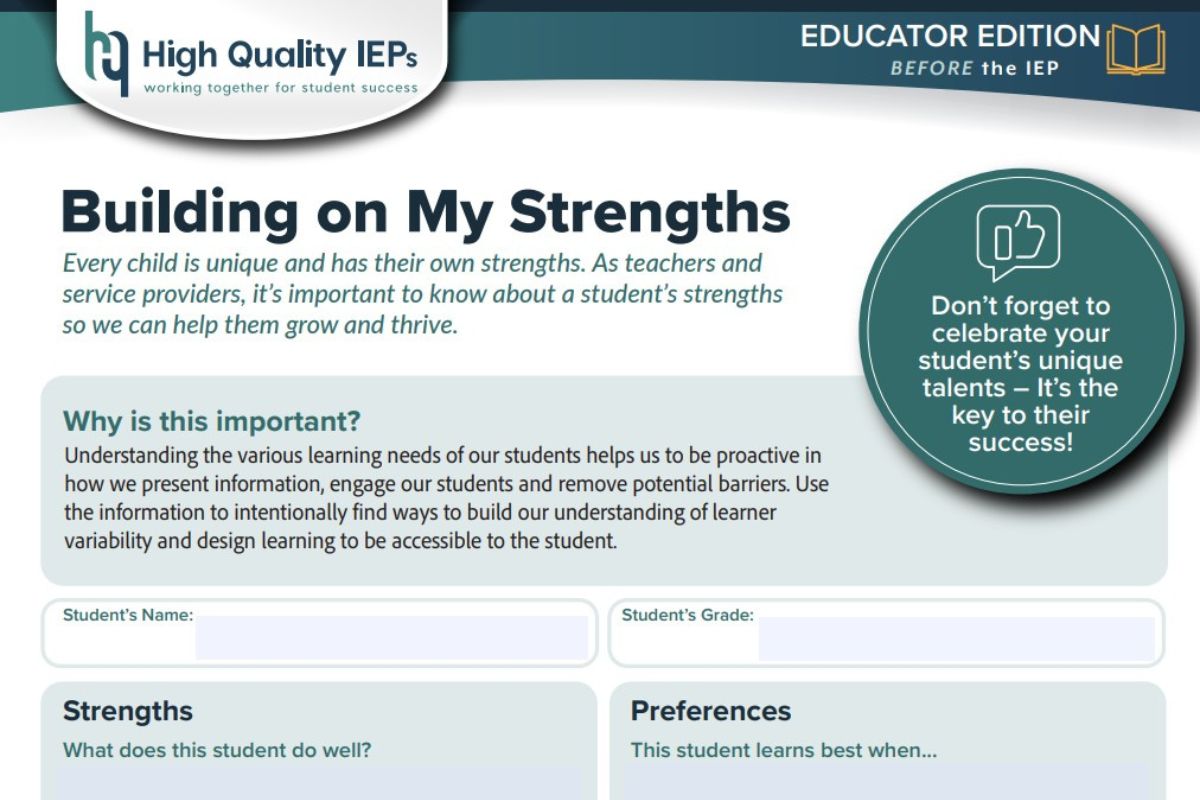
Building on My Strengths (Educator Edition)
Manage

Add to lists

Only you can see these lists - view your lists on the My Learning page.


Unsave

This will also remove this resource from any lists you have added it to.

Yes, I would like to unsave
detail-img-lg
Type:
  Printable Tool
Authors:
Heather DiFede; Leo Mapagu; Jennifer Yales, Ed.D.; Noreen Rodriguez-Lippincott; and Hinda Nadif, Ed.D.
Developed by:
High Quality IEPs (HQ IEPs)
Relevant categories:
Disabilities Special Education
This is a printable tool.
Click to download and review.
View document

Overview


This flyer introduces the goals of High-Quality IEPs (HQIEPs) and provides an overview of resources aimed at helping educators build capacity for equity-driven IEP development. It emphasizes reflective practices, family partnerships, and clear communication. Designed for use in professional learning settings, this flyer helps teams align IEP work with inclusive values.

TPE Alignment:

  • TPE 1.2 - Maintain ongoing communication with students and families, including the use of technology to communicate with and support students and families, and to communicate achievement expectations and student progress.
  • TPE 4.5 - Promote student success by providing opportunities for students to understand and advocate for strategies that meet their individual learning needs and assist students with specific learning needs to successfully participate in transition plans (e.g., IEP, IFSP, ITP, and 504 plans.)
  • TPE 6.4 - Demonstrate how and when to involve other adults and to communicate effectively with peers and colleagues, families, and members of the larger school community to support teacher and student learning.

Navigating this Collection:

HQ IEPs > Before the IEP > Preparing Educators for the IEP

  Keywords: Academic, Collaboration, Disability, Educational Benefit, Functional, Goals, IEP, IEP Compliance, Individualized Education Program, Present Levels, Special Education, Strengths Based, Student Led IEP, Student Outcomes, Student-Centered, TPE 1.2, TPE 4.5, TPE 6.4

Related items


Preparing Educators for the IEP

This collection provides educators and school leaders with practical tools to lead and participate in IEP meetings that are collaborative, efficient, and student-centered. It includes guides for establishing group norms, annotated agendas to support inclusive planning, and flyers to promote clarity around team roles and culturally responsive practices. Whether you’re an experienced administrator or a new team member, these resources support strong family-school partnerships and equity-driven decision-making in IEP settings. TPE Alignment TPE 1.2 - Maintain ongoing communication with students and families, including the use of technology ...

 Resource Collection
  Added on 10/16/2025
Preparing for the IEP - All About Preschool/Elem PowerPoint Template

This PowerPoint resource introduces families and educators to the key aspects of special education services in preschool and elementary school. It walks through how children qualify for services, what an IEP includes, and how families and educators can work together to support children’s learning and development. Whether you’re just starting your journey with special education or want to better understand how to collaborate with school teams, this guide provides clear, accessible explanations of important processes and terms—all in family-friendly language. TPE Alignment: TPE 1.2 - Maintain ongoing ...

 Website
  Added on 10/16/2025
  https://docs.google.com/presen...
Creating Self-Awareness

This professional development resource supports administrative designees in preparing for their role during IEP meetings. It includes reflective questions, a checklist of responsibilities, and guidance on how to ensure meetings are compliant, collaborative, and culturally responsive. It’s a great resource for new administrators or those seeking to strengthen facilitation skills. TPE Alignment TPE 1.2 - Maintain ongoing communication with students and families, including the use of technology to communicate with and support students and families, and to communicate achievement expectations and student progress. TPE 6.4 - Demonstrate how ...

 Printable Tool
  Added on 10/16/2025
Annotated Meeting Agenda

This annotated agenda walks educators through each stage of an IEP meeting with detailed notes and tips for facilitation. It includes guidance on language to use, how to create space for family voice, and suggestions for equity-based reflection. This tool is especially useful for administrators and case managers who lead IEP meetings. TPE Alignment: TPE 1.2 - Maintain ongoing communication with students and families, including the use of technology to communicate with and support students and families, and to communicate achievement expectations and student progress. Navigating this Collection: HQ ...

 Website
  Added on 10/16/2025
  https://docs.google.com/docume...
Meeting Norms Sample

This example shows how meeting norms might be presented visually during a real IEP or team meeting. It can be used as a template or inspiration for schools looking to create their own team-specific norms. TPE Alignment: TPE 1.2 - Maintain ongoing communication with students and families, including the use of technology to communicate with and support students and families, and to communicate achievement expectations and student progress. TPE 6.4 - Demonstrate how and when to involve other adults and to communicate effectively with peers and colleagues, families, ...

 Website
  Added on 10/16/2025
  https://docs.google.com/docume...
Meeting Norms List

This one-page handout offers a simple list of suggested meeting norms to support productive and respectful IEP meetings. Designed to be used or adapted by IEP teams, the list includes examples like listening actively, being on time, and assuming positive intent. Teams can use this list to set shared expectations at the beginning of each meeting. TPE Alignment: TPE 1.2 - Maintain ongoing communication with students and families, including the use of technology to communicate with and support students and families, and to communicate achievement expectations and ...

 Website
  Added on 10/16/2025
  https://docs.google.com/docume...
Key Component 2: Student Profile and Present Levels

This resource helps educators and teams develop a comprehensive student profile that includes strengths, interests, and present levels of academic and functional performance. It emphasizes the importance of capturing a whole-child view to guide service decisions and goal-setting, with practical strategies for organizing and presenting information during the IEP meeting. TPE Alignment: TPE 4.5 - Promote student success by providing opportunities for students to understand and advocate for strategies that meet their individual learning needs and assist students with specific learning needs to successfully participate in transition ...

 Printable Tool
  Added on 10/16/2025
Unlocking Educational Benefit: Key Component 2: Present Levels

This video explains the “present levels” section of the IEP — a clear, data-based snapshot of a student’s current skills in academics, communication, and social-emotional areas. By highlighting both strengths and needs, present levels help guide meaningful goals and services. It’s a key step in making sure the IEP is tailored to support each student’s success. TPE Alignment: TPE 1.2 - Maintain ongoing communication with students and families, including the use of technology to communicate with and support students and families, and to communicate achievement expectations and ...

 Video
  Added on 10/16/2025
General Education Teacher Quick Reference Guide

This quick-read chart makes it easy to understand the difference between two important education plans: the IFSP (for infants and toddlers) and the IEP (for preschoolers and up). With clear side-by-side comparisons, it explains who each plan is for, how they’re developed, and what services they provide—helping families and professionals navigate the transition between early intervention and school-based support. TPE Alignment: TPE 1.2 - Maintain ongoing communication with students and families, including the use of technology to communicate with and support students and families, and to communicate ...

 Printable Tool
  Added on 10/16/2025
Key Component 2: Present Levels - Downloadable Training Package

Support your LEA teams with our downloadable training packages for Key Component #2: Present Levels - complete with an agenda, Google Slides presentation, and processing guide. Click below to access ready-to-use and customizable materials designed to guide teams in gathering comprehensive meaningful data on student's strengths, preferences, needs, and areas of interest. Learn how to document disability impact, special factors and present performance to create a strong foundation for individualized, asset-based IEPs.  TPE Alignment: TPE 4.5 - Promote student success by providing opportunities for students to understand ...

 Website
  Added on 11/13/2025
  https://docs.google.com/presen...
Added on 10/16/2025   ·   Last updated on 10/16/2025

Welcome to Arraya Learning!

Arraya Learning is a centralized, evidence-based resource hub developed and vetted by leading experts across the University of California (UC) and California State University (CSU) systems. It’s designed to meet the evolving needs of educators, teacher educators, and leaders across California.
1 / 3

Getting Started

Based on the preferences you selected when creating your account, we will personalize your learning experience by recommending resources that fit your interests. You can change your interests or update your email settings on the My Profile page.

Use the Search bar or Catalog to find specific resources or browse through recommended or recently added resources.

The LEARN menu keeps track of your activities and is your way to access Courses, Trainings, Webinars, and more.
2 / 3

Key Terms to Get You Started

Course - Interactive, asynchronous learning courses that can be taken independently.
Webinar - A live, informational session held virtually or in-person. Recordings are available after the live session.
Training - A workshop, seminar, or presentation held virtually. Pre-recorded “anytime training” sessions are also available.
Resource Collection - A curated set of resources on a specific topic or strategy.

Find these and more on the Arraya Homepage and in the LEARN menu!
3 / 3
UC|CSU Collaborative for Neuroscience, Diversity, and Learning University of California The California State University
Copyright © 2024-2025 UC|CSU Collaborative for Neuroscience, Diversity, and Learning
About   |   Terms   |   Privacy   |   Accessibility   |   Contact
Saved! (Manage)
Unsaved
Changes saved! (Manage)
Are you sure you want to unsave this resource?