Overview: Spoken Language Development
Early language skills are the strongest predictor of later academic achievement and social success (Pace et al., 2018). During the first eight years of life, children experience rapid language development, laying the foundation for literacy, communication, and cognitive growth. Strong language abilities support reading comprehension, critical thinking, and social interactions, all of which contribute to long-term educational and professional opportunities. Investing time and resources in early language development not only enhances school readiness but also reduces disparities in educational outcomes, fostering more equitable outcomes for all children. By prioritizing early language skills, educators, caregivers, and policymakers can help shape a future in which all children have the tools to thrive.
Note: The current course focuses on the development of spoken language and does not address sign language or alternative communication systems. We acknowledge that sign language development plays an equally critical role in supporting learning and success for deaf and hard-of-hearing children and those who use alternative communication modalities, though these topics are beyond the scope of this course.
Language development encompasses five key components: phonology (sounds), semantics (meaning), syntax (grammar), morphology (word structure), and pragmatics (social use).
-
Phonology (Sounds): The system of sounds in a language, including how they are organized and used to create words (e.g., knowing that "cat" and "bat" are different words because of their first sounds).
-
Semantics (Meaning): The meaning of words and sentences, including how words relate to each other (e.g., understanding that a "dog" is an animal and not a fruit).
-
Morphology (Word Structure): The way words are built from smaller parts, like prefixes, suffixes, and root words (e.g., "unhappiness" = "un-" (not) + "happy" + "-ness" (state of being)).
-
Syntax (Grammar): The rules for how words are put together to form sentences (e.g., "The dog chased the cat" makes sense, but "Chased the dog cat the" does not).
-
Pragmatics (Social Use): The way language is used in different social situations (e.g., understanding when someone says "It is chilly in here" they mean they are cold or want the heat turned on; knowing how to take turns in a conversation).
Developmental Progression
Language development unfolds in a predictable order, but each child reaches each stage at different rates. In this section, we’ll explore the typical progression of spoken language skills, beginning with comprehension—also called receptive language—which refers to a child’s ability to understand words and language. This is followed by production, or expressive language, which is the ability to use words and sentences to communicate with others. While the information below offers a general overview of how language skills usually develop, it’s important to remember that children grow and learn at their own pace.
Language Comprehension
Language comprehension is the ability to understand spoken, written, or signed language. It develops before children start producing language and is a foundational skill for later communication, reading, and learning.
Why is Language Comprehension Important?
- Helps children understand what is being communicated to them, such as following directions and engaging with others around them.
- Supports vocabulary growth and acquisition of productive language.
- Plays a critical role in early literacy and academic success.
Developmental Timeline of Language Comprehension
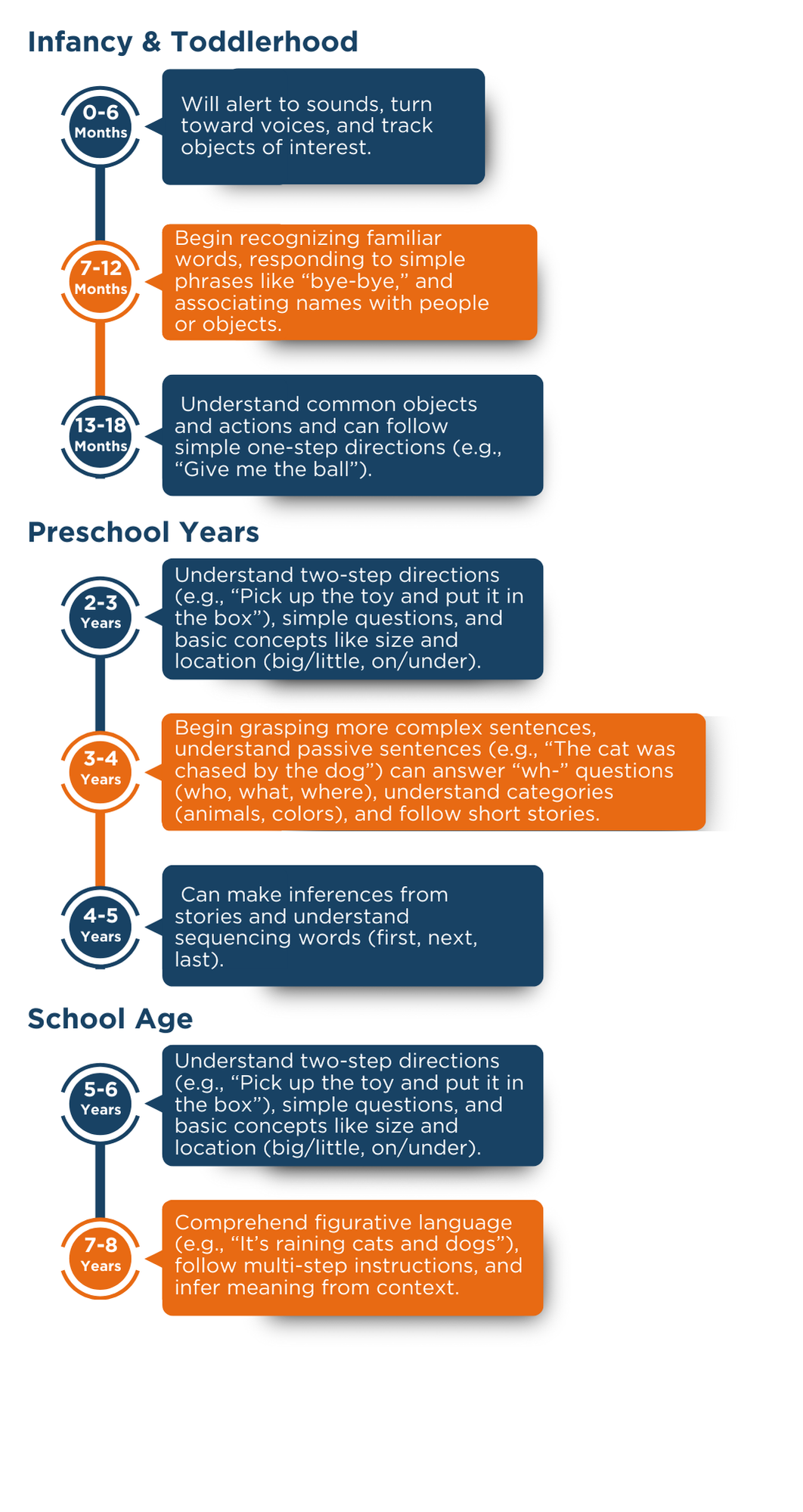
The following video provides a brief overview of general language comprehension developmental milestones from birth to 8 years old.
Language Production
Children can begin to communicate long before they actually produce their first words. Spoken language production refers to a child’s ability to use sounds, words, and sentences to communicate thoughts, needs, and ideas. This ability develops in stages, starting with cooing and babbling and progressing to complex sentences and storytelling.
Why is Language Production Important?
-
Supports communication and social interaction with caregivers, teachers, and peers.
-
Facilitates learning and cognitive development by allowing children to express thoughts and ask questions.
-
Builds a strong foundation for literacy, as speaking and listening skills contribute to reading and writing.
-
Encourages problem-solving and emotional expression, helping children navigate their world.
Developmental Timeline of Language Production
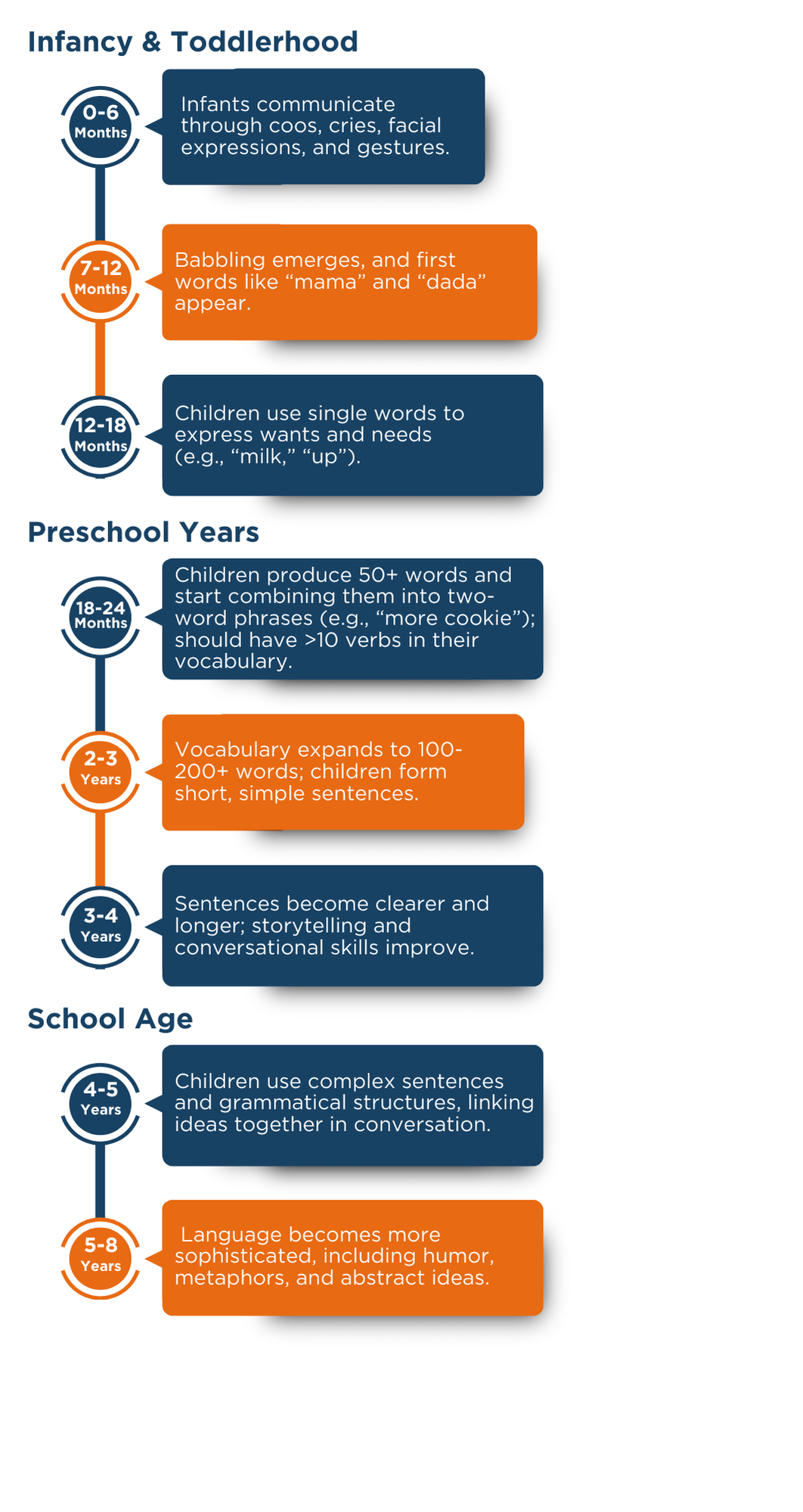
The following video provides a brief overview of general language production developmental milestones from birth to 8 years old.
Resources
For more detailed developmental milestones and checklists, we encourage you to explore resources provided by the following organizations:
Knowledge Check
This knowledge check was adapted from the American Speech and Hearing Association (ASHA) Communication Milestones Quiz. To take the full, original quiz, please visit: https://www.asha.org/public/developmental-milestones/communication-milestones-quiz/
How children learn language
Learning language is one of the most important and complex tasks of early childhood. Language allows children to connect with others, express their needs and ideas, and make sense of the world around them. But it’s also incredibly challenging—children must figure out the meanings of thousands of words, the rules for putting them together, and how to use language differently in different situations. Here we describe a few of the ways in which children learn critical aspects of language, including phonology, morphology, semantics, syntax, and pragmatics.
1. Statistical Learning
Children are incredibly skilled at picking up patterns in the language they hear. This process, known as statistical learning, helps them figure out which sounds tend to go together (phonology) to create a word (semantics) and how words are combined (syntax & morphology). For example, infants can detect where one word ends and another begins just by listening to the likelihood that certain sounds follow others. These early skills form the foundation for later vocabulary (semantics) and grammar development (syntax).
Example: The following video demonstrates the concept of Statistical Learning based on seminal research by Saffran et al. (1996). It provides a quick Statistical Learning task that you can use to test how well you, or your students, can learn patterns in language.
Key takeaway: Even before they speak, children are tuning in to the structure of language all around them—highlighting the importance of rich, consistent exposure to spoken language.
2. Fast Mapping
Once children start learning what sounds go together to create words, they then must map that word label to an object in their environment to learn the word’s meaning. Children can do this exceptionally quick, with only one or two exposures children can map labels to objects in their environment —a process called fast mapping. This allows for rapid growth in vocabulary, especially between ages 2 and 6. Fast mapping supports learning in the area of semantics and morphology—children quickly assign meanings to new words based on clues from their environment and from how the word is used in a sentence.
Example: In the following video (from 1:01-2:07), you will see a child hear “Where’s the sprock?” while seeing two familiar objects and an unfamiliar object. They assume sprock refers to the unfamiliar object and begin to map that label to the unfamiliar object.
Key takeaway: Children are active learners, making smart guesses about word meanings based on limited information—pointing or labeling things in the environment can help them make those connections.
3. Quick Interactive Learning
Quick interactive learning refers to how children learn language rapidly through real-time, social exchanges with adults or peers. Face-to-face conversations, reading together, and back-and-forth exchanges (even simple ones like turn-taking in sounds) support development across phonology (hearing and producing sounds), morphology (understanding and using word parts like prefixes and suffixes), semantics (learning new words), syntax (understanding and using sentence structure), and pragmatics (understanding the social aspects of language).
Key takeaway: Responsive, engaging interactions—like commenting on what a child sees or expanding on their speech—build deeper language understanding than passive exposure alone (like overhearing TV). For example, if a child says, “Doggy run,” you can say, “Yes, the dog is running” to help expand their speech.
4. Learning from Experience and Context
Children also learn language through repeated experiences and exposure to words in meaningful contexts. This includes routine phrases during daily routines (e.g., “Time to wash your hands”) and exposure to diverse sentence structures and vocabulary across settings.
Learning from context strengthens semantics (deepening understanding of word meanings) and exposure to a variety of sentence structures supports growth in morphology and syntax.
Key takeaway: Contextualized language—tied to what children are doing or seeing—helps them remember and use language more effectively.
The Neural Basis of Early Language Development
Language development depends on the maturation and interaction of specific brain regions and neural pathways. From birth, the brain is primed to process language, but rich input from the environment is essential to strengthen and refine these systems over time.
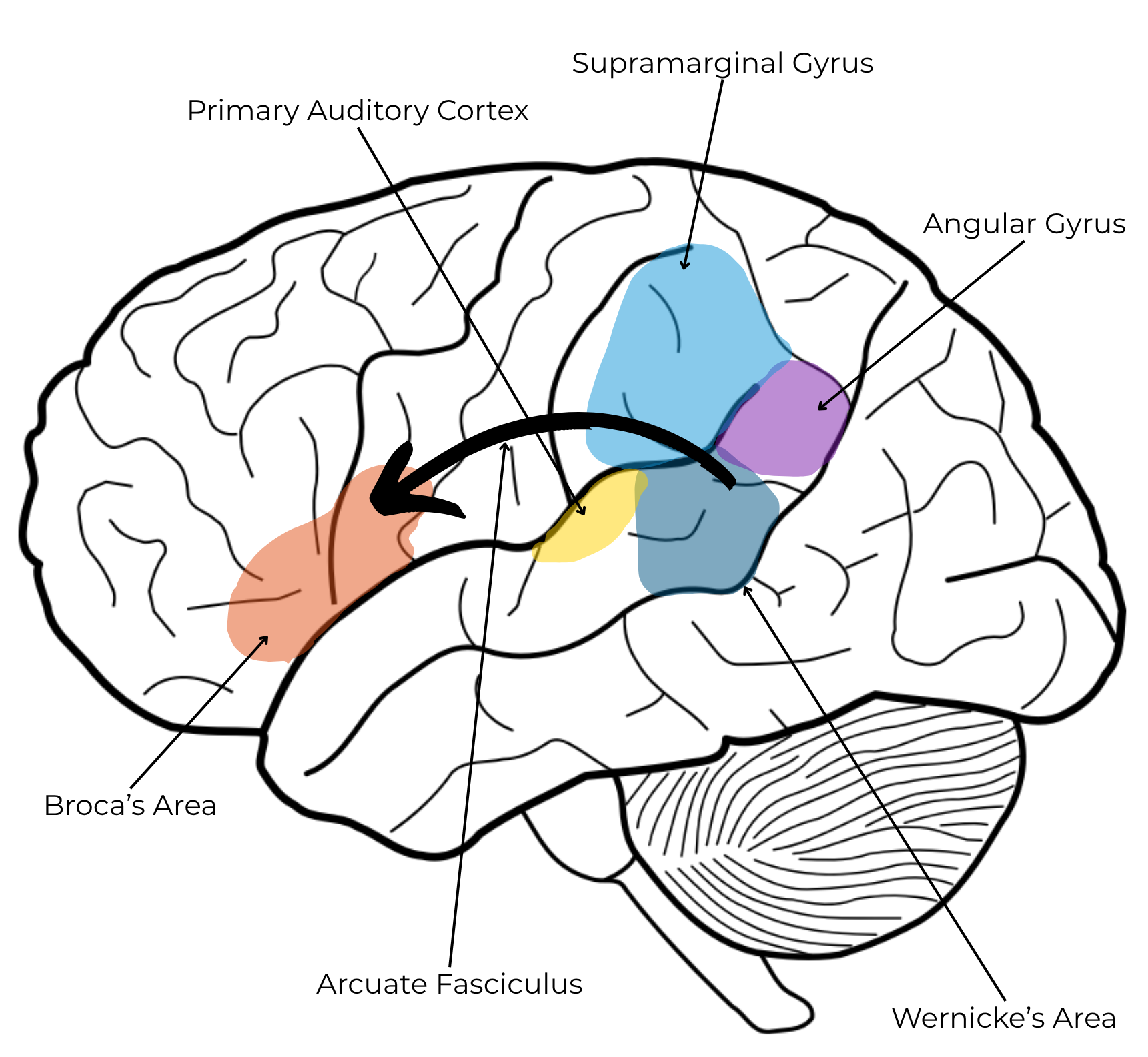
Key brain regions involved in language development:
-
Broca’s area (frontal lobe): Supports language production and grammar (syntax).
-
Wernicke’s area (temporal lobe): Involved in understanding word meanings (semantics).
-
Primary auditory cortex (temporal lobe): Processes sounds, including speech sounds (phonology).
-
Arcuate fasciculus: A white matter tract connecting Broca’s and Wernicke’s areas—supports language integration.
-
Angular gyrus and supramarginal gyrus (parietal lobe): Helps link sounds to meaning and support reading and writing.
Developmentally, these regions become increasingly specialized and interconnected throughout early childhood, with the most rapid growth occurring in the first 3 years, and continued refinement into the early school years.
The Influence of Experience on Language-Related Brain Regions
Brain development is shaped by both biological maturation and experiences—especially during the first years of life. Two important terms from developmental neuroscience help us understand this process:
Experience-Expectant Processes
This type of brain development relies on universal experiences that nearly all children are exposed to, such as hearing spoken language, seeing faces, or moving their limbs. The brain “expects” these inputs at specific developmental windows. For language:
- Hearing spoken language early and often is critical.
- Language regions like Broca’s and Wernicke’s areas depend on exposure to speech to form the neural circuits needed for understanding and producing language.
- If this expected experience doesn’t occur (e.g., extreme neglect, deafness without sign language exposure), the brain may miss the window to fully develop those systems.
Experience-Dependent Processes
These are brain changes that occur in response to individual-specific experiences—they are not universal, and they vary widely between children. For language:
- Learning new vocabulary, multiple languages, or reading print all strengthen and refine circuits in a child-specific way.
- For example, reading enhances the angular and supramarginal gyri as children link sounds to letters.
- Bilingual children may show stronger connectivity in the arcuate fasciculus, as it supports switching between languages and managing multiple vocabularies.
Why This Matters for Educators
Understanding this framework helps educators recognize:
- The critical importance of early exposure to rich language input—talking, reading aloud, singing, and meaningful conversation—especially in the first 3 years when experience-expectant development is most active.
- The power of continued experience through storytelling, interactive reading, writing, and multilingual instruction to further shape and strengthen the language network well into the school years.
By creating language-rich environments—especially for children who may not receive these inputs consistently outside of school—educators help unlock the full potential of children’s developing brains.
Individual Differences
Although children typically develop their language skills in the developmental windows described in the previous section, there is significant variability in how and when they acquire language skills. Differences in early experiences, caregiver interactions, exposure to multiple languages, and access to learning opportunities all shape a child’s language trajectory. Additionally, neurodivergent children—such as those with developmental language disorder (DLD), autism spectrum disorder (ASD), or other cognitive differences—may develop language skills along unique paths.
Understanding individual variability in language development is essential for educators, as it allows them to support diverse learners effectively. Recognizing that some children may need more exposure, explicit instruction, or alternative communication supports ensures that all students have equitable opportunities to build strong language skills. By adapting teaching strategies to meet each child’s needs, educators can create inclusive learning environments that foster communication, learning, and social connection.
Environmental Experiences
Variability in Language Input
The quantity and quality of language input that children receive play a crucial role in shaping their language development. Research shows that children who hear more words and engage in more conversational turns with caregivers develop stronger vocabulary and language processing skills (Hart & Risley, 1995; Bornstein & Tamis‐LeMonda , 1989; Weisleder & Fernald, 2013; Donnelly & Kidd, 2021). High-quality interactions—such as responsive, back and forth—enhance children’s ability to process and learn new words more efficiently. In contrast, children who experience limited verbal engagement may develop language skills at a slower rate, highlighting the importance of rich, interactive language exposure in early childhood.
Watch the following 4 minute video to gain a better understanding of how language input shapes early language development and key strategies you can do to better engage young children in conversations.
Socioeconomic status/poverty
Socioeconomic status (SES) is a complex construct, defined by related, but not identical, factors, such as parental educational attainment, occupational status, neighborhood quality, and family income. Children from different SES backgrounds may have varying access to language-rich experiences, which can influence their language trajectories. Studies indicate that, on average, children from higher-SES families are exposed to more diverse words (Rowe, 2008), more complex syntax (Huttenlocher et al., 2007; 2010), and more back-and-forth conversations (i.e. conversational turns; Romeo et al., 2018; Ferjan Ramírez et al., 2020; Hirsh-Pasek et al., 2015) than children from lower-SES backgrounds (Hoff, 2003; Rowe, 2012); all of which are linked to positive language outcomes. However, as discussed above, research emphasizes that it is not just the number of words heard, but the quality of interactions that matters most (Gilkerson et al., 2018). While SES-related language differences can emerge early, interventions that promote caregiver-child interactions and increase access to high-quality early learning environments can help bridge language disparities.
Watch the following 15 minute video by Dr. Meredith Rowe to gain a better understanding into SES-related differences in language development, and existing interventions that seek to enhance the quality of language interactions with young children.
Multi-/Bi-lingual populations
Children growing up in bilingual or multilingual environments may develop language skills differently from monolingual peers, often distributing their vocabulary knowledge across multiple languages. While bilingual children may have smaller vocabularies in each individual language compared to monolinguals, their total conceptual vocabulary—the combined knowledge across both languages—is often comparable (Pearson, Fernández, & Oller, 1993) or even larger when you consider both languages (Byers-Heinlein et al., 2023). Research also suggests that bilingualism supports cognitive flexibility and executive functioning (Bialystok, 2009). Importantly, variations in exposure to each language, the age of acquisition, and language use across different contexts all influence how bilingual children develop language skills, emphasizing the need for educators to understand diverse language trajectories and avoid misidentifying bilingualism as a language delay.
In the following 10 minute video, Dr. Mileidis Gort dispels common myths about early bilingual development and explains why understanding its benefits matters in today’s multicultural world.
Language Variation and Dialect
Language develops not only across different languages but also through natural variation within a language. Dialects are systematic, rule-governed variations of a language tied to regional, cultural, or social groups. In the U.S., for example, African American English (AAE), Southern American English, and Chicano English are all valid and meaningful dialects used by millions of speakers. These dialects reflect rich cultural identities and histories and follow consistent grammatical patterns, even when they differ from what is considered “Standard American English.”
Understanding dialectal variation is essential for educators and clinicians, as failure to do so can lead to misidentification of language disorders. For instance, children who speak a non-mainstream dialect may be mistakenly perceived as having limited language skills or as needing intervention, when in fact they are demonstrating linguistic competence within their speech community. Research highlights the importance of distinguishing language difference from language disorder (Washington & Craig, 2004; Mallinson et al., 2011).
Educators play a critical role in affirming students’ linguistic identities while also supporting their ability to navigate academic language expectations. Culturally responsive teaching strategies can help build on students’ home language strengths, promoting both language development and academic success. Embracing dialect diversity not only supports learning—it also fosters a more inclusive classroom climate where all forms of communication are valued.
The following 20 minute video by Dr. Anne H. Charity Hudley describes the importance of acknowledging language varieties in an educational context.
Neurodivergent populations
Developmental Language Disorder (DLD)
Developmental Language Disorder (DLD) is a neurodevelopmental condition affecting a child’s ability to acquire and use language despite typical cognitive and sensory abilities (Leonard, 2014). Children with DLD often struggle with vocabulary acquisition, grammatical development, and sentence structure, with difficulties persisting into adolescence and adulthood (Conti-Ramsden et al., 2018). Unlike children with general language delays, those with DLD do not “catch up”, making early identification and support critical.
For educators, understanding DLD is essential because these students may have strong intellectual abilities but struggle with classroom tasks that require verbal comprehension and expression. Teachers can support students with DLD by using visual aids, scaffolding verbal instructions, and incorporating explicit language instruction into daily learning activities (Ebbels, 2014). By recognizing the signs of DLD and adapting teaching approaches, educators can help reduce language-based learning barriers and improve academic success.
Please visit DLD and Me to learn more from Dr. Lisa Archibald about actionable strategies educators can implement in the classroom to make language instruction more accessible for children with DLD.
Autism Spectrum Disorder (ASD)
Note: The autism community varies in preference between person-first (individual with autism) and identity-first language (autistic individual). For the purposes of this course, we use identity-first language.
Autistic children display a wide range of language development trajectories, from those who acquire language typically to those who remain minimally verbal (Tager-Flusberg & Kasari, 2013). Some autistic children have difficulty with social communication, pragmatic language use, and understanding nonliteral language such as idioms or sarcasm (Eigsti, de Marchena, Schuh, & Kelley, 2011). While some autistic children develop language at a delayed but steady pace, others experience atypical patterns.
Educators must be aware of these diverse language trajectories to provide effective support for autistic students. Structured interventions like augmentative and alternative communication (AAC) and explicit instruction in social communication can improve language outcomes (Kasari et al., 2014). Additionally, a flexible, individualized approach that includes both verbal and nonverbal communication strategies helps create an inclusive classroom environment where autistic students can thrive.
Please visit Autism Speaks to learn more from Drs. Geri Dawson and Lauren Elder about actionable strategies you can use to promote language development in children and adolescents with nonverbal autism.
Research-Based Strategies to Support Early Language Development
Educators play a critical role in fostering language development by creating rich, engaging, and language-filled environments. Research shows that intentional strategies, such as interactive storytelling, guided play, and explicit vocabulary instruction, can significantly enhance children’s language skills (Wasik & Hindman, 2018). Below are evidence-based strategies that support various aspects of language development.
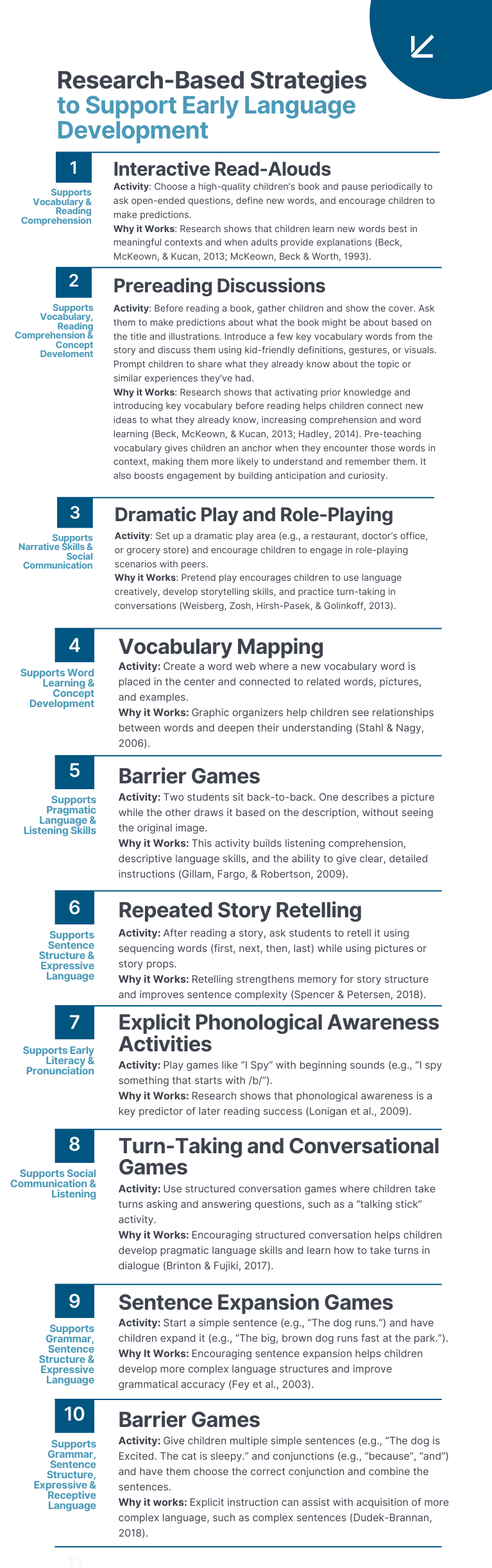
Download these strategies by clicking on the following PDF:
Knowledge Check: Matching Activity
Match the strategy on the left to the language skills it primarily supports on the right.
Drag and drop the terms on the right to match with the corresponding terms on the left.
- Interactive Read-Alouds
- Dramatic Play and Role-Playing
- Barrier Games
- Explicit Phonological Awareness Activities
- Sentence Expansion Games
- Vocabulary & Comprehension
- Pragmatic Language & Listening Skills
- Grammar, Sentence Structure, Expressive Language
- Early Literacy & Pronunciation
Final Assessment
References
Download the following PDF to view the list of references cited throughout this course: